






Recently, while preparing for a trip, I had an epiphany. I had already checked in for my flight virtually using my airline's app, and I was in the process of using a stand-alone kiosk at the airport to verify my passport with facial recognition. The experience was surprisingly smooth, intuitive, and seamless. It got me wondering: Why — in an era of mobile deposits, one-click purchasing, and predictive personalization — can't we use the same principles to improve the patient experience in healthcare?
At Holyoke Medical Center, we recently launched our Digital Front Door Strategy. The initiative aimed to reduce administrative burden and significantly improve the patient experience by enhancing patient access and providing streamlined, self-service options.
This initiative was driven in part by state requirements to improve the collection of Race, Ethnicity, Language, and Disability information (RELD); Sexual Orientation and Gender Identity information (SOGI); and Social Drivers of Health data. Our goal was to make it easier for patients to enter this information themselves and ensure it flowed seamlessly into Expanse. Recognizing that this can be sensitive data for both patients to share and staff to collect, we felt that a self-service model could make communicating this information more private, secure, and comfortable for patients and staff alike.
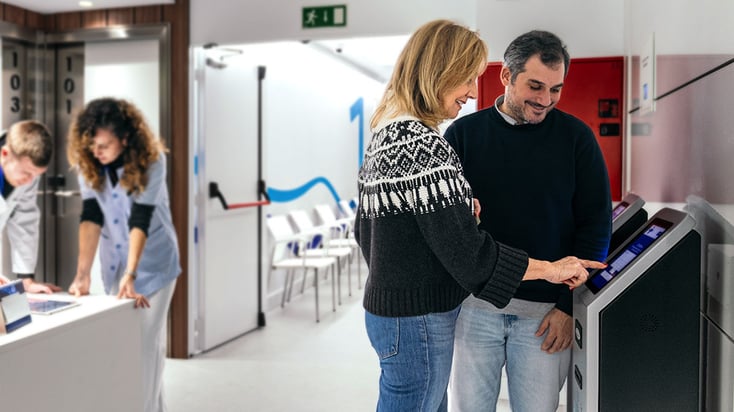
To reduce administrative burden, we developed a system that encourages patients to pre-register, complete required questionnaires, and make co-payments before arrival, supported by text reminders. Secure, accessible kiosks are also available for patients who prefer to complete these steps on-site or may feel hesitant to enter information such as credit card details on their phone.
By identifying friction points in our current processes and improving workflows, we enabled patients to submit discrete data that is automatically filed in the EHR. To support this effort, we partnered with MEDITECH to implement custom interfaces that would integrate a third-party kiosk vendor's data into our Expanse EHR. Our primary objectives for implementation included:
- Pre-registration: To expedite demographic and clinical intake by collecting patient information beforehand.
- Patient-led check-in: To reduce staff workloads and patient wait times by enabling check-in via kiosk, mobile device, or tablet.
- Patient collections: To present and collect accurate patient pays, co-pays, and outstanding balances before care, making patients aware of what is due and providing them with a way to make payments on the spot.
- Custom questions: To collect specific data about a patient’s current visit to build awareness for premium services or to ensure the right accommodations, like wheelchair needs, were available.
The results of the Digital Front Door Strategy have been overwhelmingly positive, demonstrating significant performance improvements. Data captured from August 1, 2024, through July 31, 2025, indicates that the percentage of patients who utilized self-check-in with no front desk intervention reached 94%, significantly exceeding the target metric of 80% (excluding PT, which has a different process due to visit frequency). The high utilization rate is further supported by the 175,000 total online transactions we tracked in 2025. Additionally, before the new process, we collected essentially no copays in person, and the new system has enabled us to collect 56% of copays on-site.
Our commitment to accessible and efficient patient self-service technology laid the foundation for the success of the Digital Front Door Strategy. We’ve successfully rolled out multiple registration and check-in options, including standalone kiosks, tabletop kiosks, and self-service via mobile device or tablet via text message or by scanning a QR code. Having these varied options allows for more personalized care, supports different workflows across clinic and hospital locations, and helps protect patient privacy.
This system allows for a single patient touchpoint where data is captured by the patient themselves and flows directly into the EHR. Our improved digital data capture processes have since proliferated across the organization and are being rolled out to ancillary departments like Diagnostic Imaging, Physical Therapy (PT), and Occupational Therapy (OT).
With our Digital Front Door strategy, Holyoke Medical Center has not only streamlined patient access and staff workflows but has also set a powerful precedent for enhancing the patient experience with accessible, self-service technology powered by Expanse.
Download our eBook: The Essential Guide to EHR Value and Sustainability