






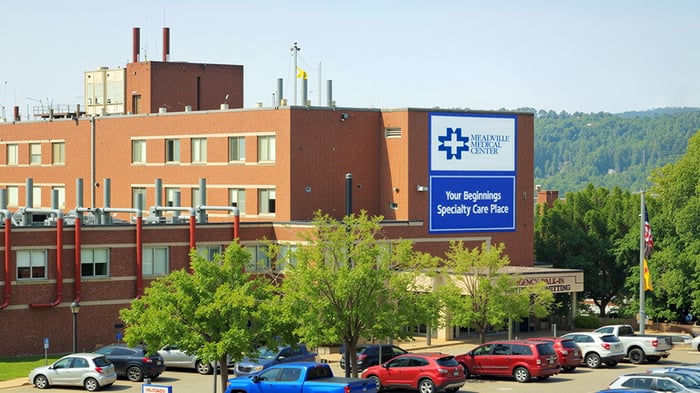
Remaining competitive in the current healthcare market is crucial for health systems — and it’s no small task, especially for rural hospitals like Meadville Medical Center. At our organization, we’ve learned that to thrive in this environment means we must think creatively, be willing to adapt, and take strategic risks.
Our two-hospital system in Northwest Pennsylvania serves roughly 100,000 people. We operate a 240-bed community hospital, a 25-bed critical access hospital, and about 50 clinics across multiple specialties. As one of only 11 independent hospitals remaining in Pennsylvania, we are dedicated to prioritizing our community impact while maintaining financial sustainability.
Meadville Medical Center has grown significantly — from a $230 million operation to over $400 million in just five years — by transitioning clinics to hospital-based models, acquiring pharmacies and additional services, and pursuing strategic opportunities that strengthen financial performance.
Embrace provider-based models
Clinics need to be flexible with billing strategies to stay competitive in today’s marketplace. We found that transitioning some of our clinics to hospital-based (provider-based) models could bring significant benefits. With this model, our organization earns revenue from both professional fees and facility fees, improving reimbursement overall. While the clinic’s charges may appear higher, there are options for strategically structuring those fees. An example of this was when one of our practices complained about facility fees; the clinic adjusted its approach — charging technical fees only for certain groups, while still charging the fees for commercial payers.
This provider-based model also ensures that the clinics are included in the hospital’s cost reports to CMS, allowing certain operational costs — like staff, equipment, and overhead — to be reimbursed more favorably, boosting overall revenue. Additionally, we’ve found that keeping clinics in the hospital system helps retain patients and referrals, strengthening market share.
Explore service line expansion possibilities
But our success goes beyond traditional hospital services to include ventures into the pharmacy business. We now own two community pharmacies and a specialty pharmacy, which significantly benefit from the 340B program. For qualifying hospitals like Meadville Medical Center, registering clinics as outpatient departments can make prescriptions eligible for the 340B drug discount program, generating considerable pharmacy savings. For hospitals that qualify for 340B, this can dramatically increase the volume of discounted drug purchasing — especially high-cost infusion and specialty medications — resulting in substantial annual savings that can be reinvested in patient care. Identifying strategies where we can leverage these funds has been crucial to our success and how we support our community.
Another key to our success is simply staying open to what comes our way. We’ve made an effort to spot new possibilities early and position our organization to act when these unique opportunities arise. This past January, we had the opportunity to take over a medical center near us. After months of discussion and running the numbers, the acquisition just didn’t make sense financially. So rather than acquiring the hospital, we decided to bring over key service lines and providers, including:
- Cardiologists
- ENT/other specialists
- Lab services
- Radiology
- OT/PT/Speech therapy
This allowed us to retain existing patient relationships while increasing revenue by continuing high-demand service lines with expert providers that patients already trusted.
Maximize strategic opportunities
We also acquired a 100-year-old nursing school, which we relocated to Meadville. The nursing school now graduates RNs and LPNs, serving as a pipeline of new nurses for the organization. In the Titusville area, we are expanding our service lines by adding several specialty clinics, including oncology and OB/GYN. We also partnered with a dental school for a residency program, and we continue to be open to unique opportunities, such as opening a clinic for the Amish community that directly bills the church rather than insurance.
At Meadville Medical Center, our focus on community impact and strategic growth has allowed us to thrive as one of Pennsylvania’s few remaining independent hospitals. By staying aware of market opportunities and creatively embracing those that benefit our community, we’ve strengthened both our services and our financial foundation — striking a balance that keeps us competitive while supporting our community. Our advice: stay open to new opportunities in your market and be willing to make strategic deals that strengthen your organization and patient population.
Discover how MEDITECH Expanse impacts communities of all sizes.