






As we approach the end of another busy year and prepare to launch into a new one, I wanted to reflect on the dramatic acceleration we’re experiencing in the adoption and use of our interoperability solutions — particularly our national data exchange network Traverse Exchange. 2025 will go down as a watershed year for MEDITECH’s interoperability team, and that’s great news for our customers and the entire industry.
2025 has been a remarkable year for MEDITECH. I mean that for both our company generally and for our interoperability efforts more specifically. Over the course of one year, we stood up our national data exchange network, providing our customers with an onramp to the wider TEFCA ecosystem. Let’s stop and think about that. In just one year we’ve connected over 600 facilities (and growing) across the US, providing them access to the national network and facilities using a wide range of other EHRs. Similarly, we’ve onboarded dozens of hospitals using Traverse Exchange in Canada, allowing them to share data with hundreds of long-term care facilities using other EHRs.
Talking TEFCA
We conducted three webinars this year on the Trusted Exchange Framework and Common Agreement (TEFCA) and the way it’s changing interoperability as we know it. Our “Talking TEFCA” series began with a primer on TEFCA’s framework, goals, and implications, along with examples of the new forms of data sharing it enables. In our second webinar, we covered how interoperability can be turned into a competitive advantage — reducing costs, improving revenue, and supporting a stronger bottom line. In the third and final event of the series, we discussed the real-world impact of interoperability under TEFCA.
These three webinars were among our most successful and well received ever, which I attribute at least partially to the inclusion of Dr. Steven Lane, Chief Medical Officer at Health Gorilla, and a practicing primary care physician and clinical informaticist with over three decades of experience advancing the use of health information and technology.
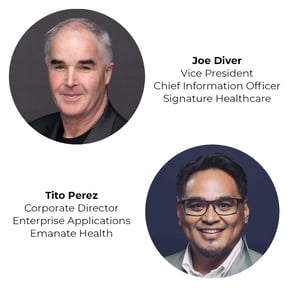 We also featured two outstanding customer speakers. Joe Diver, Vice President and Chief Information Officer at Signature Healthcare discussed why interoperability is critical to his organization’s strategy as an independent organization in the highly competitive Boston metropolitan healthcare market. And Tito Perez, Corporate Director Enterprise Applications at Emanate Health shared key insights and metrics around his organization's use of Traverse Exchange.
More Data is Not Better
What I found most exciting about what we learned from Joe and Tito was just how thoroughly they understand our vision for Traverse Exchange, and how the solution is being received. They both certainly know very well why interoperability has been so difficult to adopt and use historically. They realize clinicians already have too much data to deal with — and too little time to make sense of it. They understand that what clinicians need is the right data, in the right place, at the right time.
 In other words, more data is not better. Better data is better. Our vision for Traverse Exchange was to intelligently curate and present data: To consolidate all available data from all sources, deduplicate it, and organize it meaningfully so that clinicians can access it efficiently (within their existing workflows), intuitively understand it, and use it to make informed decisions.
It’s arriving just in time. Physicians had largely given up on interoperability — disregarding outside data because they couldn’t find the needles in the haystack. Our approach with Traverse Exchange brings the needles to the surface. It collapses potentially dozens of CCDs into one consolidated view — organizing all encounters, diagnoses, medications, procedures, and other data from sources outside of the EHR into a single view, at the click of a button. No longer do physicians need to wade through hundreds of pages of CCDs to see if there’s anything meaningful. Traverse Exchange does it for them.
And physicians are getting it. Tito shared a story that has inspired my team ever since. He said that one of his physicians, upon seeing the new Consolidated Patient Summary in Traverse Exchange for the first time, exclaimed “I have to have this. When can I have this?” They didn’t need to be told what they were seeing. They understood immediately that external, interoperable data from multiple sources was being displayed on a single screen, organized in a way that made sense to them. That’s what makes Traverse Exchange such a game changer. We truly believe that it’s the most intuitive interoperability solution available today. There are other vendors that share data between organizations using their own EHR, but nobody is bringing together data from other EHRs like MEDITECH.
Learn how MEDITECH's Traverse Exchange national data exchange network is benefiting customers like Frederick Health in Frederick, MD and Emanate Health in the San Gabriel Valley, CA.
MEDITECH LIVE
As we’ve continued to onboard additional organizations to our data sharing network, the wider MEDITECH community (and even organizations using other EHRs) are beginning to grasp its significance. A clear sign was the standing-room-only crowds at MEDITECH LIVE in our new Interoperability & Data Pavilion, where we demonstrated real-world patient scenarios featuring interoperable data exchange across care settings. But interoperability was by no means siloed at the pavilion. It featured prominently in nearly all of our general sessions and several breakout sessions as well. That was an unmistakable sign that interoperability is no longer a “nice-to-have” feature, but a mission critical component for organizations of all sizes and locations.
 MEDITECH Alliance and Greenfield Workspace
Additional evidence that the wider healthcare community is beginning to recognize MEDITECH’s momentum is the continued rapid growth of the MEDITECH Alliance, which now boasts more than 50 members — a 40% increase over last year. Many participants in the alliance use FHIR-based tools developed by our interoperability team, and our Greenfield Workspace app development environment continues to see impressive levels of activity, with new alliance members joining and testing their apps against our EHR.
The Best is Yet to Come
I’m proud of how far we’ve come in the past year — but the future is even brighter. As the wider system of QHINs expands, and more and more healthcare organizations using different EHRs join the “network of networks,” clinicians will have access to even more and better data. Earlier this year, we committed to the pledge to implement the CMS Interoperability Framework and enable 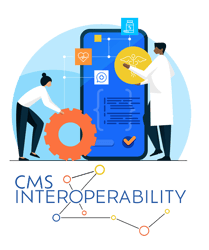 our provider customers’ participation in CMS Aligned Networks. But our commitment to interoperability runs much deeper than a public pledge. We’ve been committed to interoperability from the start. We were one of just four vendors selected to participate in the ONC Test EHR Pilot Program and the first to successfully support CCD.
Today we’re still leading the charge, with a FHIR-first approach that’s putting real-time data in the hands of clinicians at the point of care — and empowering patients as active stewards of their health data. Recently, we demonstrated how a patient can access their aggregated health data, including data from health systems on our Traverse Exchange network using a patient health app (like HealthEx, for example) that connects to a CMS Aligned Network like Health Gorilla. This crucial ability to access comprehensive, consolidated health information using Individual Access Services puts an end to the outdated, inefficient, and often error-prone method of manual record-keeping, effectively “Killing the Clipboard.”
Another exciting initiative we’ll be advancing in 2026 is to bring together two major streams of development at MEDITECH: Interoperability and Artificial Intelligence. Today, our Expanse Navigator solution searches across the EHR, legacy data, scanned documents, and even handwritten notes — using AI to rank, sort, and return results. Now we’re working on leveraging these same tools to process larger volumes of interoperable data over our Traverse Exchange network. Just imagine the ability to search not only within your own EHR, but across all EHRs connected via TEFCA, and return intuitively ranked and sorted results. This will be the culmination of the vision of true healthcare interoperability that many of us have had for over two decades, and I expect MEDITECH to be the first to achieve it.
And finally, we’re working on several enhancements that will streamline the revenue cycle, support prior authorization, perform real-time eligibility checking, and create cleaner claims from clinical notes with fewer errors. The end result will be fewer denials, quicker reimbursement, and improved cash flow — all things that are top of mind for healthcare leaders.
I expect to be even busier in 2026 — onboarding additional organizations to the Traverse Exchange network, enhancing workflows, adding new tools for patients and payers, and making real-time, in-workflow access to external data a reality for more and more clinicians.
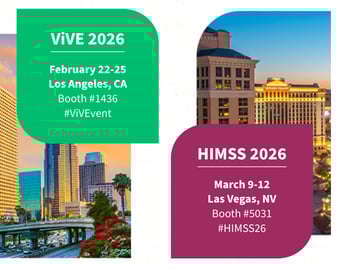 See It (and Believe It)
Don’t just take my word for it. Come see it for yourself. I encourage you to visit us at either or both HIMSS and ViVE in 2026. We’ll be showcasing Traverse Exchange along with our AI solutions, cloud-based offerings, genomic medicine solution, and so much more. I’ll be excited to provide and update on the growth and expansion of our data exchange network and the additional enhancement we’re developing. Please come find me if you’ll be at any of these events.
Finally, I encourage you to sign up for our Connections newsletter. It’s the best way to stay up to date on all things interoperability at MEDITECH — and there will be a lot to keep up with in 2026!
Learn more about how MEDITECH is advancing the charge towards intelligent interoperability.



.jpg)