






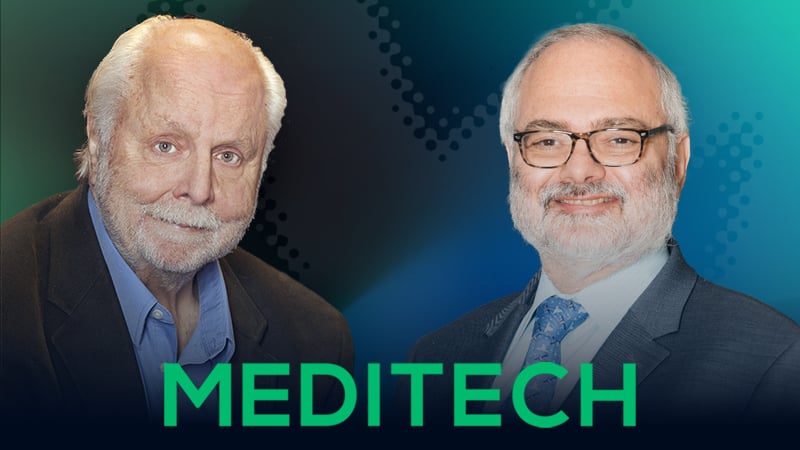
 When I first joined MEDITECH as a programmer in 1974, I thought maybe I would stay for a year or two before heading back to grad school. (Ha.)
I was young and ambitious, a proud “computer nerd” with a degree in electrical engineering from MIT and a plan to get my PhD. Last month, after five decades with MEDITECH, I was appointed Chair of the Board of Directors. I can hardly believe how fast the time has gone by and how far technology has progressed in my lifetime. I can still remember when computers were the stuff of science fiction; something groovy we saw on “Star Trek.” Today, they’re fully enmeshed within all of our everyday routines — including our healthcare.
A few months ago, the man who hired me for the job of a lifetime, MEDITECH’s longstanding CEO and Board Chair, passed away at 83. When I first met him, Neil Pappalardo was best known for co-developing MUMPS, the revolutionary programming language he and fellow informatics pioneer Curt Marble first implemented at Massachusetts General Hospital in 1966. I was impressed by his journey from upstate New York to MIT, which laid the foundation for what would eventually become the Health IT industry. MUMPS was the first computer system designed specifically for healthcare, replacing paper charts with efficient, queryable digital databases.
Neil co-authored Design and Implementation of a Clinical Data Management System, published by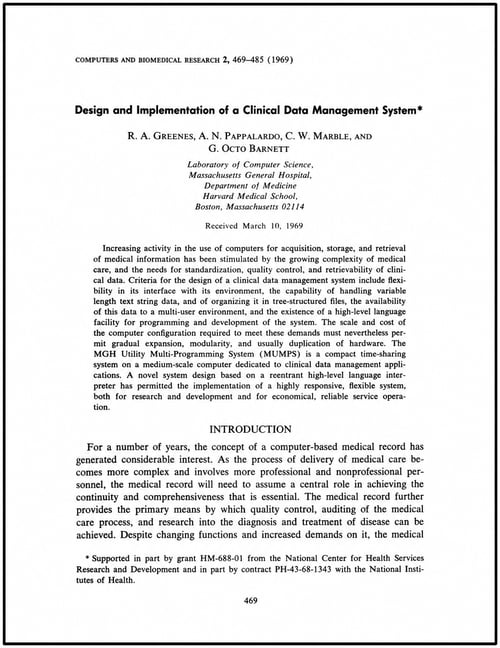 Computers and Biomedical Research in 1969. This groundbreaking paper discussed the origins of MUMPS and how it addressed specific needs in healthcare data management, including:
-
Flexibility and interface requirements
-
Hierarchical (tree-structured) data organization
-
Multi-user, time-sharing access to information
-
High-level language and symbolic data management
-
Efficient use of resources and modularity
The technology Neil and his colleagues created would become the foundation for ALL healthcare IT systems currently in use. Without it, this industry would look very different today. He began a national conversation about the potential for automation of electronic medical records, which continues to evolve to this day.
Neil was an inspiration to me. He saw firsthand the inefficiencies of paper-based systems in healthcare and sought creative solutions where none had existed before. When he founded MEDITECH, he focused on establishing an innovative, developer-driven, problem-oriented company culture. It was the perfect place for 22-year-old me to grow my programming skills. But if the challenge of creating cool new technologies was why I started working there, it was Neil’s mission to improve healthcare for patients and clinicians that kept me going over the years.
Neil’s influence stretched far beyond his creation of healthcare’s first programming language. He inspired new tech entrepreneurs and freely shared his knowledge to help them succeed. This includes Epic CEO Judy Faulkner, who revealed some of his contributions to her early career and to the founding of Epic during a recent interview with journalist Katie Couric. The technical guidance he offered would jumpstart the health IT industry, deliver its first truly integrated patient record, and accelerate the pace of innovation for many years to come.
One thing that today's healthcare workers have in common with generations past: none of them want to be replaced by computers. Nor should they be; the human-centered nature of medicine demands that clinicians practice with compassion and a personal touch. But finding the time and focus to devote to one-on-one patient interactions is where EHR technology can now have an even greater impact.
We’re already seeing, for example, how Artificial Intelligence is opening new avenues to both improve the clinician experience and empower patients. Clinicians can complete their documentation by automatically generating clinic visit notes and inpatient assessments, and queuing next steps in their workflow. These tools are improving efficiency, yes. But they are also nurturing human connections by freeing up clinician time to focus on the patient.
Working closely with clinicians over the years has deepened my own understanding of how healthcare IT impacts the daily lives of its users. Collaborations with customers were instrumental in guiding the evolution of MEDITECH’s system — particularly the Expanse platform, which was built from the ground up to center on user-friendly mobile technologies and to create a single, integrated, interoperable EHR record across all care settings.
Patients are finding better access to their own health data through mobile devices. Health information is quite literally at patients’ fingertips, and patient portals and apps have opened up a new world of proactive decision-making and more substantive conversations with their doctors.
When we talk about access to care, we also have to talk about sustainability. The most innovative technologies in the world can only have an impact if they are affordable for organizations of all sizes and in all locations. This has been an important part of MEDITECH’s long-term strategy to bring innovation worldwide by partnering with diverse customers across America, Africa, Ireland, Australia, and the UK. I believe that healthcare technology vendors share a responsibility to help keep costs down and to drive discussion around value. To that end, our cloud-based subscription model has helped level the playing field for many rural and community organizations that wish to offer cutting-edge services while remaining independent.
But there’s still more to do.
Change can be complicated — full of potential and also a bit scary. But change has also long been a constant in our industry, as we’ve seen both technology and healthcare rapidly transform with the times. I often think about Neil, how I will miss his unique perspective as MEDITECH moves forward. But what I mostly feel now is gratitude — for his contribution to healthcare, for his mentorship, and for creating a legacy that reflects the integrity, intelligence, and caring our world needs now more than ever.
I have a strong sense of pride and enthusiasm for all we have already accomplished. And I’m confident that Neil’s foundation has set MEDITECH on a path to an even brighter future, with many innovative solutions still to come. Onward and upward!
.jpg)